
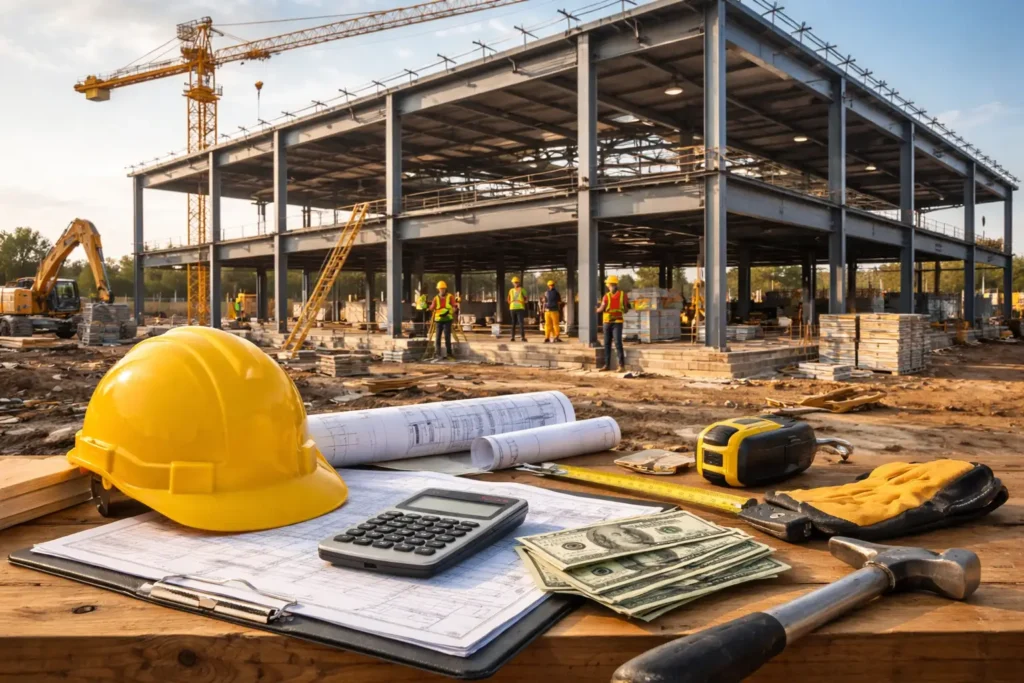
Business owners, real estate investors, and developers who are planning a new project need to know the cost to construct a 5,000 sq ft commercial building in the United States. The costs of a commercial construction depend on the location, the type of the building and design complexity, including the simple industrial shells, and the luxurious office areas with the specialized finishing. Commercial construction costs usually fall between $240 and $870 per square foot across the country, reflecting commercial construction costs per square foot. This depends on the region and the size of the job.
By knowing these costs upfront, decision makers can budget, acquire funding, and choose the best design and construction method. This tutorial will explain how much a 5,000-square-foot commercial building might cost and how materials, labor, and location affect the pricing.
What Determines Commercial Building Costs?
When making a budget for a 5,000-square-foot project, understanding the cost to construct a 5,000 sq ft commercial building is helpful. There are a lot of different factors that affect how much commercial construction costs in the U.S. The cost per square foot usually falls in a broad range depending on the type of building and where it is located.
Location & Regional Differences
Costs depend a lot on where you build. Because land is worth more, rules are stricter, and labor is more expensive, urban and coastal markets tend to be more expensive. A significant portion of the Southwest and the Midwest, where the cost of labor and materials is lower, can be significantly less expensive. If you’re staying in the same state, bigger places like New York tend to be more expensive than the smaller ones.
Building Type & Complexity
The building’s use and style are important. Most of the time, medical offices, labs, and multistory office buildings cost more per square foot than a 5000 sqft warehouse or simple industrial shells. Costs go up when there are more complicated structural elements, mechanical and electrical systems, and design elements.
Materials & Finishes
Options for materials, from basic steel and concrete to high-end finishes like curtain walls or high-end interior systems, can affect your budget. Price changes in the market for steel, lumber, and concrete also have an effect on costs.
Labor & Local Regulations
Costs of labor depend on where you live and how skilled the workers are. In big cities, union labor is especially expensive. It takes more time and costs more money to follow local building rules, safety standards, and permit processes.
Design, Permits, & Site Conditions
Total costs include fees for permits, the complexity of the design, the technical needs, the preparation of the site (grading, utilities, and demolition), and the materials needed. There could be a major rise in the cost of the site work caused by problematic soil or environmental issues.
Typical Commercial Construction Cost per Sq Ft in the U.S.
To estimate the cost to construct a 5,000 sq ft commercial building, multiply the cost per square foot by the total building size. In the U.S. in 2026, commercial construction prices vary a lot depending on the type of building, how complicated it is, where it is located, and the level of finish.
It costs between $240 and $870 per square foot to build a commercial building in the United States, but this depends on the size and level of finish. Complex facilities or high-end facilities are placed to the high end and basic structures to the low end.
Cost by Building Type (Typical U.S. Ranges)
| Building Type | Approximate Cost per Sq Ft (U.S.) |
| Basic Office (single‑story) | $240 – $440 |
| Office (mid‑rise) | $330 – $870 |
| High‑rise Office | $430 – $1,000+ |
| Retail/Shopping Center | $370 – $580 |
| Warehouse / Industrial | $210 – $800 |
| Healthcare / Clinic | $450 – $1,020 |
| Community / Public Facilities | $430 – $1,270 |
What This Means in Real Terms
- Lower Complexity Buildings: Simple stores and offices with only one story tend to be on the cheaper end of the price range, at around $240 to $440 per square foot.
- Mid-Range Commercial Space: Standard mid-rise offices and shopping centers usually cost between $330 and $580 per square foot.
- Specialized or High-End Projects: This cost quickly rises in buildings with complex mechanical systems, medical requirements, and high-end finishes; examples are hospitals, labs, museums, and health facilities that can easily run upwards of more than $1,000 a square foot.
Why These Ranges Vary
Costs vary widely for numerous reasons:
- Structural Complexity: Taller buildings and buildings with a lot of mechanical systems need more engineering, resources, and work.
- Finish Standards: High-end finishes inside and out make the price per square foot much higher.
- Location and Labor: Different areas have different labor rates, local rules, and permit requirements, which drives up prices in cities with lots of demand.
Estimated Cost to Build a 5,000 Sq Ft Commercial Building
To estimate the cost to construct a 5,000 sq ft commercial building in the U.S., you need to know the range of prices per square foot. The most recent construction cost guides say that the average cost of building a business building in the U.S. is around $560 per square foot, with costs ranging from $240 to $870 per square foot for general buildings.
Low End Scenario — Basic / Minimal Specifications
Costs tend to be cheaper for a commercial building that is simple and does its job, like a basic warehouse, shell office, or simple light industrial building. At about $240 per square foot, the cost of a 5,000-square-foot building would be:
Cost ≈ $1,200,000 (5,000 sq ft × $240 psf).
This scenario usually has basic structural elements and interior finishes. There may be no custom features, finishes, or electrical or mechanical installations.
Mid Range Scenario — Standard Office / Retail Build
An average office building or storefront reflects the retail construction cost range for a commercial job. At a normal price of $400 to $500 per square foot, your 5,000-square-foot building would cost:
Cost ≈ $2,000,000 – $2,500,000.
This includes good interior finishes, working HVAC systems, useful electrical and plumbing installs, and obeying basic construction codes without enhancements.
High End Scenario — Specialized or Premium Build
Costs per square foot can rise sharply for specialized buildings, increasing the cost to construct a 5,000 sq ft commercial building. With high costs, prices can reach $870 psf or more, close to the national average.
Cost ≈ $4,000,000 – $5,000,000+ for 5,000 sq ft at $800 – $1,000+ psf.
This situation includes advanced MEP systems, custom features of the architecture, the high quality of materials, and possibly, the necessity of the multi-story structure requirements.
Regional Cost Variations
In the U.S., location is just as important as building type when estimating the cost to construct a 5,000 sq ft commercial building. Costs for commercial construction vary a lot from one area to another because of differences in labor markets, material prices, building codes, and permit fees.
Why Costs Vary by Region
- Labor and Wage Levels: Because of high demand and union rates, labor prices tend to be higher in major metro areas and coastal cities.
- Material Prices: Transportation, tariffs, and regional supply impact steel, concrete, and lumber prices.
- Permitting & Building Codes: Tougher rules for the environment, earthquakes, or energy use (like in California and New York) cost more time and money.
- Regional Demand: Due to increasing development demand, less competitive areas charge more.
General Regional Cost Trends
- East Coast: New York and Boston are two of the priciest cities in America. Due to labor costs, density, and complex regulations, commercial construction costs tend to exceed the overall American average.
- West Coast: The cost may vary in places such as Los Angeles, San Francisco, and Seattle due to factors such as coast, earthquakes, and the environment.
- Midwest: The primary factor that makes business projects cheaper in states such as Illinois, Ohio, and Indiana is that labor and market costs are cheaper compared to projects based on the coast.
- South: Places like Texas, Georgia, and Florida are often more affordable. The cost of labor and obtaining a permit is also usually lower in the South, although those costs tend to increase in areas that are prospering.
Cost Breakdown: Hard Costs vs Soft Costs for a 5,000 Sq Ft Commercial Build
In the U.S., it is important to know how to divide up the total cost of building a 5,000-square-foot commercial building when making a budget. There are two main types of construction costs: hard costs and soft costs. Each type affects different parts of the job and your overall budget in a different way.
Hard Costs — Direct Building Expenses
Hard costs are the real, physical expenses that define the industrial building cost per sq ft. These account for 70–80% of commercial project costs.
Main hard cost components:
- Materials: Steel, concrete, wood, roofs, finishes, and more.
- Labor: Wages for builders, electricians, plumbers, freelancers, and other workers.
- Equipment & Site Work: Such as heavy machinery, temporary buildings, grading, digging, and wiring up utilities.
Because they depend on materials and work done on-site, these are the basic costs that make your 5,000-square-foot building a real thing. They are also easier to predict and keep track of.
Soft Costs — Indirect, Essential Expenses
While not directly related to building, soft costs still affect the cost to construct a 5,000 sq ft commercial building. When it comes to commercial buildings, soft costs usually make up between 20 and 30 percent of the big project cost.
Common soft cost categories:
- Architectural & Engineering Fees: Include design, building plans, and technical models.
- Permits & Inspection Fees: Permission from local government, review of zoning laws, and safety inspections.
- Project Management & Administrative Costs: These would include costs associated with supervision, planning, and organization.
- Legal, Accounting & Financing Fees: Just as there are interest rates on any loan, there are the legal fees, insurance, etc.
These costs usually happen before, during, and even after construction. The costs of financing and insurance are two examples. Planning for “soft costs” early prevents budget overruns and ensures all services and permits are available.
Typical Cost Distribution (Rule of Thumb)
| Cost Category | Approx. % of Total Budget |
| Hard Costs | ~70–80 % |
| Soft Costs | ~20–30 % |
| Contingency | 5–10 % (extra for unforeseen issues) |
Most commercial estimates believe labor and material costs dominate the budget, while soft costs are considerable but less yet still necessary for planning, compliance, and financing.
Cost Saving Strategies for Commercial Construction
The cost to construct a 5,000 sq ft commercial building is high, but careful planning can reduce expenses. Follow these up-to-date, tried-and-true tips:
- Value Engineering: Early on, look at the design and materials to find cheaper options that do the same job, reducing costs that are not necessary. Cost consultants or engineers should be involved in the planning process to get the most savings without lowering the quality.
- Prefabricated & Modular Construction: Built modules and parts away from the construction site can save money on labor, speed up the process, and reduce waste on the site.
- Competitive Bidding: Ask subcontractors to submit more than one bid so that prices are more fair and you can find the best deal.
- Early Contractor Involvement: Include your builder in the planning stages to make the best use of time, materials, and procedures.
- Efficient Materials & Systems: Pick long-lasting, common materials and systems that use less energy to save money in the short and long run.
Final Thoughts & Recommendations
Planning the cost to construct a 5,000 sq ft commercial building requires a solid budget from the start. Coordinating cost, schedule, and quality early on helps you make smart choices instead of reacting to surprises later on. For long-term performance, proactive budgeting links these important parts into a single plan, rather than using expensive stop gaps once building starts.
Working with professionals or commercial estimating services ensures accurate cost figures. Modern estimating tools help compare projects from 5,000 sq ft to a 50 000 square feet building accurately.
To cover unexpected costs and keep your project on pace, consider contingency funds and evaluate your budget regularly. This rigorous technique lets you trust your budget and track your money while construction.