
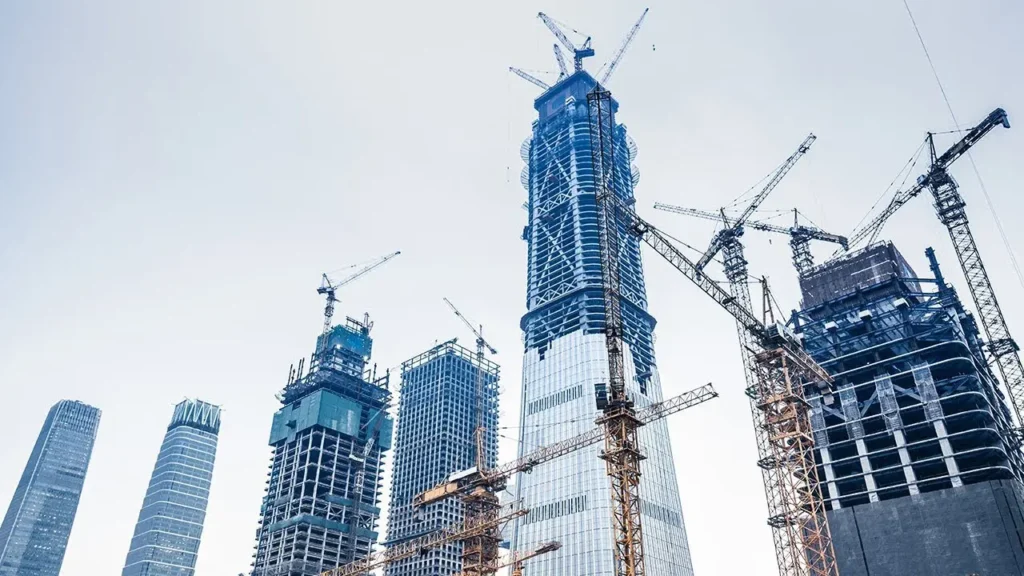
Building a skyscraper is still one of the biggest and most expensive projects in the construction world in 2026. Skyscrapers require more engineering, materials, labor, and design than smaller projects to safely attain extraordinary heights and meet modern building requirements. Depending upon the size, location and objectives of the design the costs can be easily tailored to few hundred million dollars to several billion dollars.
Developers, investors, city leaders, and students all need to know how much does skyscraper cost before planning. There are many things that affect the costs of these huge projects, such as the cost of land and the design of the buildings, as well as the costs of materials, labor, and permits. Fusion Estimating, in this blogpost breaks down the main cost factors affecting the cost to build a skyscraper in 2026.
What Defines a Skyscraper?
Not just any tall building, a skyscraper is a very tall, continuously livable construction that rises far above its surroundings and needs advanced engineering to support its height. Most modern building standards and agreements say that a skyscraper should be at least 150 meters (492 feet) tall. Most of the time, buildings below this height are just called “high rises” or “tall buildings.”
Early steel-framed buildings in the late 1800s were about 10 to 20 stories tall. Today, the word “skyscraper” refers to much taller buildings made possible by reinforced concrete, steel frames, and vertical transportation systems like elevators.
In practice:
- Tall buildings can be as tall as 50 m, which is more than 14 stories.
- Most skyscrapers are taller than 150 m
- “Supertall” refers to buildings taller than 300 m, and “megatall” refers to buildings taller than 600 m.
Commercial spaces, residences, hotels, and mixed-use developments (which blend different functions into one vertical structure) are all common uses for skyscrapers.
How Much Does It Cost to Build a Skyscraper?
Skyscraper construction in the U.S., remains one of the most expensive and complicated undertakings in 2026. Location, height, design, materials, labor markets, and permitting laws affect costs, but industry estimates provide a solid range for developers.
Overall National Cost Range
Major U.S. skyscraper projects cost hundreds of millions to billions to develop, reflecting the overall cost of skyscraper development. Smaller high-rises can cost hundreds of millions, whereas famous metropolitan towers show the true price of a skyscraper, often exceeding $1 billion. Mixed-use skyscraper projects like Hudson’s Detroit, completed in 2025, cost approximately $1.4 billion for a 49-story building.
- High-end office and residential towers in New York and Chicago can cost over $1 billion to $3 billion+, depending on height and features.
- The entire expenditures include land acquisition, structural construction, interiors, elevators, mechanical systems, design, and permitting.
Cost Per Square Foot Benchmarks
Construction cost per square foot is a frequent benchmark used to measure the cost to build a skyscraper accurately. In the United States, for business high-rise buildings:
- High-rise and skyscraper projects often cost $400-$1,500+ per square foot, depending on location and quality.
- General commercial development in 2025-2026 is normally cheaper, with costs ranging from $240 to $870 per square foot for offices, retail, and industrial buildings.
- Premium skyscrapers in large cities with complicated structural systems, curtain wall façades, innovative mechanical systems, and premium finishes tend to have high cost per square foot.
How These Numbers Fit Real Projects
To contextualize these numbers:
- A mid-sized skyscraper can cost $300M to $800M+, showing how high the cost to build a skyscraper can be.
- Skyscrapers often cost upwards of $1-3 billion, explaining how much is a skyscraper when fully developed.
Due to union labor rates, land scarcity, tougher laws, and higher permitting costs, location premiums, notably in New York City and San Francisco, can drive up costs. Although there is little data on the cost of skyscrapers in the region, commercial cost trends indicate that the high-rise construction is more costly in large regions than in small cities in the U.S.
Breakdown of Major Cost Components
Building a skyscraper is a multifaceted investment where the cost to build a skyscraper depends on numerous cost categories. Developers must plan for land, design, materials, labor, and regulations in 2026. Let us look at the main factors that affect the total cost.
Land Acquisition
Land purchase is one of the most unpredictable and often largest up-front costs affecting the cost to build a skyscraper. A suitable block of land can cost hundreds of millions of dollars in key metropolitan markets, especially in global cities like New York or London, sometimes more than the structure itself. Premium locations near transit hubs or business centers are most expensive because tenants value access and visibility.
However, before the actual construction begins, one has to think about the cost tied up with site preparation, removing existing buildings, and so on. In metropolitan areas, which are congested, security and site preparation could cause additional delays and costs.
Design and Planning
Design and planning create the project’s blueprint and directly influence the cost to build a skyscraper. Along with the schematic design, structural analysis, sustainability planning, and contractors and advisors, architects and engineers also create fees. Skyscraper design may easily exceed millions or tens of millions of dollars due to the complexity of the structural systems, high-performance exteriors, and building systems required to interact.
Developers must pay for planning, zoning, and feasibility studies before breaking ground. Complex designs with unique aesthetics or advanced sustainability elements take longer and cost more during this stage.
Materials and Labor
The majority of skyscraper construction costs are materials and labor, forming the core cost to build a skyscraper. Steel, reinforced concrete, glass curtain walls, elevators, mechanical systems, and interior finishes cost money. A 2026 U.S. commercial high-rise development may cost $240–$870+ per square foot for basic structure and shell work, more for premium finishes or complicated systems.
Labor is frequently the highest expense because skyscrapers require large ironworker, concrete finisher, HVAC, and electrician crews. Cities with high unionization and pay have higher labor expenses.
Even with relatively stable inflation, contractors in 2026 remain alert about material pricing patterns, as steel and aluminum prices rise globally. Mechanical, electrical, plumbing (MEP) systems and advanced safety devices in buildings add millions to hard expenses.
Permits, Regulations & Soft Costs
Soft costs, essential for legal compliance and project management, significantly impact skyscraper project budgeting. Construction permits, impact fees, insurance, environmental studies, project management, and legal services. Soft costs range from 10% to 30% of the project price, depending on local rules and complexity. In high-regulation markets, permits for tall structures with strict fire safety and structural requirements might cost hundreds of thousands or millions.
Cost Per Floor and Per Square Foot Metrics
Developers estimate 2026 skyscraper construction costs per floor and square foot to better evaluate the cost to build a skyscraper.
Cost Per Floor
The cost of one skyscraper level varies. Recent data shows the cost of floors ranges from $3 to $10 million in different markets, largely depending on location, design complexity, and building use. The emerging markets and less congested cities could be more affordable compared to global iconic hubs like New York, London, Dubai, or Singapore, where labor and material costs are high.
Cost Per Square Foot
Cost per square foot is a more precise technique to assess skyscraper prices. Most commercial data presently shows a range of $400 to $1,500+ per square foot worldwide for high-rise and skyscraper projects, reflecting structural requirements, safety systems, façade quality, and interior finishes.
High-rise commercial construction costs in the US range $430 to over $1,000 per square foot, with higher rates in densely constructed urban cores like New York City due to labor and regulatory demands.
Examples by Building Scale
- Mid rise skyscrapers (20–40 floors): Typically cost $100-$500 million.
- Tall skyscrapers (40–70 floors): Can total $500 M–$1 B+.
- Supertall constructions (70+ floors): Often reach $1B.
Taller buildings require stronger structural systems, more advanced safety and elevator systems, and longer construction deadlines, which raise floor and square foot costs.
Financing a Skyscraper: What Developers Need to Know
Skyscraper financing is one of the most complicated commercial real estate financial puzzles because the cost to build a skyscraper rarely comes from one source. A capital stack is a way for developers to organize their funding. It layers different types of financing to balance risk and gain.
Developers often contribute a minor amount of equity while lenders and investors provide the rest of funding. Ownership holdings and future returns in equity investments such as the private equity firms, pension funds and REITs may cost a lot of money initially.
Skyscraper finance relies on construction loans. Construction milestones trigger these short-term loans for hard and soft construction costs. Borrowers usually pay interest only during construction and subsequently refinance or pay off the loan.
Pre-sales or tenant commitments (such signed leases before completion) decrease lender risk and improve financing terms. In 2026, rising interest rates have raised borrowing costs, forcing developers to carefully manage financing options including bridge loans or private finance to optimize cash flow and project sustainability.
Future Trends Affecting Skyscraper Costs
Several issues are affecting skyscraper construction costs in 2026, increasing the cost to build a skyscraper across markets.
Material and Labor Pressures
Construction materials and labor pressure is a trend. Some important material prices have leveled off, but steel and aluminum prices are still high due to tariffs and changes in the supply chain, which affects the total cost of the project. In many markets, labor shortages raise wages and increase scheduling risk for large projects. The two considerations make forecasting and cost control extremely important.
Modular and Prefabrication Technologies
Construction methods like modular and productized are another effect. Offsite prefabrication of main components reduces labor, speeds production schedules, and lowers costs. These strategies are becoming more realistic ways to improve tall building delivery efficiency as organizations use more standardized, repeatable components.
Sustainability and Regulatory Demands
Regulatory and sustainability requirements affect cost planning. New energy regulations require more insulation, facades, and mechanical systems; however, this increases construction costs while providing savings later on.
Conclusion
Skyscraper building remains one of the most resource-intensive projects, reinforcing the massive cost to build a skyscraper. Due to land prices, labor rates, and regulations, global financial center projects cost more than emerging market projects. The numbers also show how labor and material costs are still being pushed around, which affects today’s building budgets.
Ultimately, there is no one cost that works for all projects, making detailed construction takeoff essential for accuracy. Please feel free to share your ideas and lessons learned if you are a builder, developer, or planner who has worked on tall building projects before.