
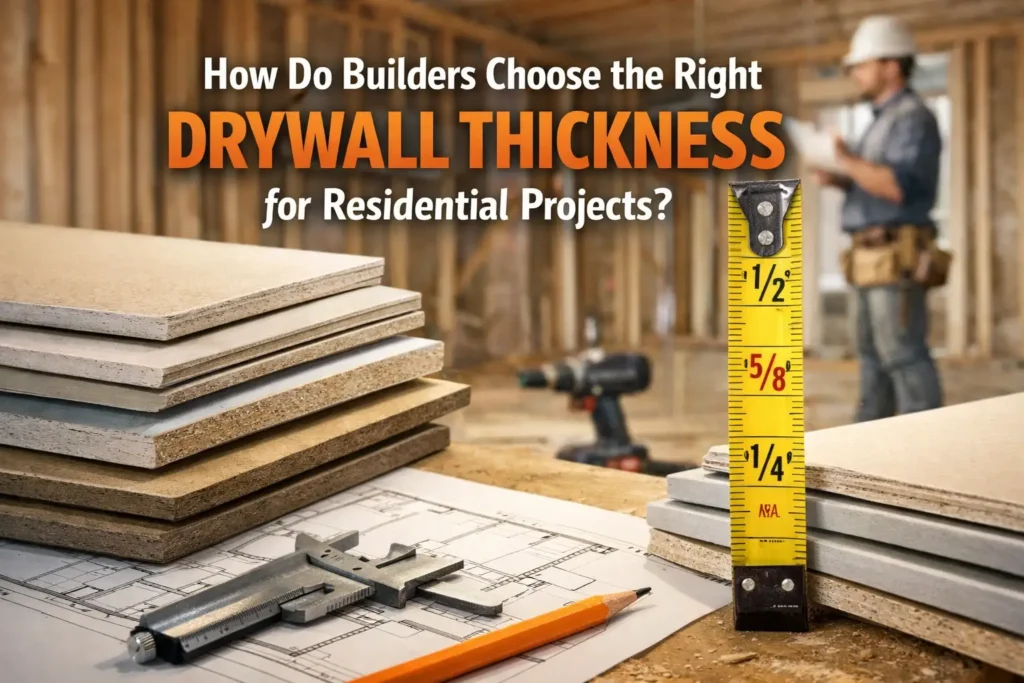
Sheetrock, gypsum board, or drywall is the common material the majority of American people are comfortable with to construct the interior walls and ceilings of homes. A lot of people like this material because it is cheap, easy to put up, and smooth for painting or wallpapering.
The correct thickness of drywall can affect fire ratings in a building, sound absorption, strength of walls and ceilings, etc. Mostly 5/8 inch-thick drywall is used in garages where fire ratings are desired or in ceilings to reduce sagging.
If the improper drywall is chosen according to the thickness, violations of building codes will occur, along with poor space performance, as well as increased material and labor expenses. Hence, the right drywall thickness is of ideal interest to residential builders as well as homeowners who often ask how thick is drywall for different areas of the home.
Drywall Basics — Materials and Standard Sizes
Drywall, which is sometimes called gypsum board or sheetrock, is a common material used for interior walls and ceilings. It is made up of a gypsum core and heavy paper facings. As a finishing layer, it makes a flat, smooth surface that helps enclose framed structures in residential construction. In the 20th century, gypsum boards became popular as a faster and cheaper option to plaster finishes.
Common Drywall Thicknesses
Drywall panels come in a number of standard sizes, each of which is best for a different use:
- 1/4 inch (6.35 mm): This is a very thin sort of panel that is very suitable in curved walls, overlays, and fixes since it is easy to bend than the other boards that are thicker.
- 3/8 inch (9.5 3): This is not a very common size these days but may be required in case of repair or enhancement.
- 1/2 inch (12.7 mm): This thickness is the typical thickness of most walls and ceilings installed in residential buildings, as it is strong, workable, and inexpensive.
- 5/8‑inch (15.9 mm): Thicker and stiffer. It may be common in areas that require greater fire resistance, sound control or sag resistance such as ceilings with wider spacing between the joists.
Standard Panel Sizes
They come in lengths of 8 to 16 feet and are 48 inches wide most of the time in the U.S. 4x8ft, 4x10ft, and 4x12ft are common sizes. Longer panels are better for higher walls because they hide the seams, which aligns with common standard drywall sizes used in residential construction.
Thickness and Performance
Thinner boards are lighter, easier to transport, and easier to install, while thicker ones are sturdier in structure, offer resistance to fire and sound, and cannot easily bend.
Building Code Requirements
Choosing the appropriate drywall thickness may not only be concerned with the effectiveness of the drywall; the building codes have established the minimum standards to ensure the safety, structural integrity and fire protection in residential construction. Most cities and towns in the United States rely on construction laws such as the International Residential Code (IRC). It provides builders with a guideline to be adhered to.
Standard Code Requirements
- For most walls and ceilings in single-family houses, 1/2-inch drywall is the recommended thickness. It meets the IRC’s general standards for covering the inside of a construction when the studs are 16 inches apart. By using this thickness, you can be sure that you are following the rules for non-fire-rated parts.
- Some applications that are fire-rated need a 5/8-inch gypsum board. The IRC and most state codes require 5/8-inch Type X drywall, which is specially made with fire-resistant core materials, to be used in places where a fire resistance rating is needed, like garage ceilings with living space above or other assemblies that need a one-hour fire rating.
Fire Rated Assemblies and Exceptions
- Type X or Type C drywall is made to slow the spread of fire, making places safer where it is needed. Standard 1/2-inch panels may not be very fire resistant, but 5/8-inch Type X is the most common diameter that meets code for walls and ceilings that are fire-rated for one hour.
- In some places or designs, different fire-rated assemblies are allowed that get the same ratings, like two layers of thinner boards. However, these must be accepted by the people in charge of the local code.
Local Code Variation Matters
Not every state, city, or county has the same building codes. Sometimes the requirements are more challenging than the IRC minimum. Builders should always check the latest local code documents or speak with a building inspector prior to buying materials to determine what thickness and type of drywall is called for in each room.
Standard Thickness Choices Explained
Builders select drywall based on width, which affects installation, fire resistance, noise insulation, and space fit. There are usually four thicknesses of drywall sheets: 1/4 inch, 3/8 inch, 1/2 inch, and 5/8 inch. Each has its use in residential construction.
1/4 Inch Drywall — Flexible & Specialized
- Main Use: 1/4-inch drywall is the smallest of all the drywall panels you could purchase. It’s mainly applied over an existing wall or ceiling in case one is renovating or making some curved surfaces, such as arches. Because it is not as thick as the thicker boards are, it is a little easier to bend once it becomes dampened.
- Not for Primary Walls: Because it is fragile and not very rigid, it should not be used as the main material for full wall or ceiling installs in new buildings.
3/8 Inch Drywall — Transitional & Repair Work
- Common Uses: 3/8-inch drywall was once used for general wall applications, but it is not as common in new construction projects. It is still used for patching, resurfacing, and some renovations where matching the thickness of the existing wall is important.
- Performance: It lasts a little longer than 1/4-inch paneling, but not as long as standard-thickness boards. It is not usually used for major walls or ceilings.
1/2 Inch Drywall — The Residential Standard
- Most Common Choice: Most U.S. residences have 1/2 inch drywall interior walls and ceilings due to its robustness, light weight, low cost, and ease of installation.
- Versatile & Cost-Effective: It can be easily fitted between 16-inch studs, is simple to move, and also hangs well in rooms that require no additional fire rating or soundproofing.
- Typical Use Cases: Living rooms, Halls, Bedrooms and normal Ceilings that are not subjected to a condition of fire.
5/8 Inch Drywall — Performance & Fire Control
- Thicker & Stronger: 5/8-inch drywall is heavier and more rigid, making it ideal for areas that need strength and durability. It is fire-resistant and sound-proof.
- Ceiling and Fire Applications: Many choose it for ceilings, most of those with 24-inch-separated joists, because it sags less than 1/2-inch boards.
- Better performance: Builders usually prefer the use of 5/8 inches for fire-rated wall spaces such as between residences or garages and sound-sensitive spaces.
- Cost and Handling: This thickness improves performance, but it costs more and is heavier to install, which requires more work and longer bolts.
Performance Considerations — Strength, Sag Resistance, Fire Safety & Sound Control
Residential drywall thickness matters. It affects how efficiently the wall or ceiling blocks sounds or crashes. When builders guarantee walls and ceilings meet code and operate, they consider efficiency.
Wall Strength and Durability
- Better resistance to impact: 5/8-inch drywall panels are thicker and contain more gypsum, which makes them stronger and better able to handle knocks and everyday wear and tear, especially in places with a lot of foot traffic.
- Reduced flex and fracture: Some panels, like 1/2-inch ones, can bend more when they are under a lot of stress, which can cause holes or cracks to form over time, especially on tall walls or walls that touch each other a lot.
Sag Resistance for Ceilings
- Gravity fights drywall: The ceiling is continuously sinking. When there is an increased gap in the ceiling joists, i.e., 24 inches, there is a certain sagging of the drywall.
- 5/8-inch advantage: 5/8-inch drywall is more rigid than other types and is thus more suitable for most ceiling applications, particularly those involving wider spaces between joists and/or a textured finish where it is undesirable for the ceiling to sag.
- Other choices: Some companies are making 1/2 inch boards that never sag and are more like the 5/8 inch boards for some applications in the ceilings. This means the boards are lighter while still doing the work.
Fire Resistance Performance
- Passive fire protection: Thicker plywood, especially when paired with Type X or Type C fire-rated boards, makes the building less likely to catch fire. This makes it easier to get out in case of an emergency.
- Common practice: Most fire-rated drywall is 5/8-inch thick and is used in places where fire-resistant barriers are needed, like on walls of attached garages.
Sound Control and Acoustics
- Mass helps to reduce noise blocking: Thicker drywall makes a better noise-blocking surface on a wall or ceiling in a room, and thicker gypsum boards can reduce noise carried between rooms.
- STC basics: Adding mass to a partition (through thickness or multiple layers) raises its Sound Transmission Class (STC) grade, which can help bedrooms or home theaters meet their sound comfort goals.
Practical Application by Room or Wall Type
To make sure that ceilings do not sag, fire protection is good, and noise does not travel too much, you should match the drywall thickness and its type to the purpose of each room. These residential areas have recommended drywall choices based on how buildings are built today.
Interior Living Spaces
- Standard thickness: Most people favor 1/2 inch drywall as the standard thickness due to its popularity and being the best choice for general-purpose interior walls in living rooms, bedrooms, hallways, etc. This type of drywall provides the best balance of strength and usability.
- Ceilings: If the framing is 16 inches apart, 1/2-inch panels will most likely do fine; however, a greater thickness could also work well.
Basements and Moisture Prone Areas
- To prevent mold and moisture damage in basements, laundry rooms, and kitchen splash zones, use 1/2-inch moisture-resistant drywall, green board, or similar.
- Basement ceilings: If the gap between the joists is large but dry, 5/8-inch panels may prevent sagging.
Garages and Fire Rated Walls
- Fire safety requirement: Walls and ceilings that need to have a fire rating, for safety reasons, such as a wall between a garage and a living room, have to have 5/8-inch thick Type X drywall to fulfill fire resistance requirements and complying with building regulations and codes.
Shared or Party Walls
- Sound control: 5/8-inch drywall or multiple layers, possibly with insulation, are better at blocking out noise than standard boards for walls separating beds, kids’ rooms, or multi-unit dwellings.
Specialty Rooms (Home Theater, Media Rooms)
- Enhanced acoustics: 5/8-inch drywall helps keep noise out of home theaters, music rooms, and other sound-sensitive areas. Adding sound-dampening materials, such as acoustic compounds or extra layers, improves efficiency even more.
Cost Implications of Drywall Thickness
When making a budget for drywall, panel thickness has a direct effect on the prices of materials and labor. Typically, heavier boards cost more per sheet and take longer to install. Prices for standard 4×8 drywall sheets range from $10 to $20, depending on thickness and type. 1/2 inch sheets are cheaper, while 5/8 inch panels are more expensive due to their increased material mass and performance benefits like fire resistance and sound control.
- Material Cost Comparison: A 1/2-inch sheet costs 10–20 USD, whereas a 5/8-inch board that fits in it costs 12–22 USD. Because the board contains more gypsum and a denser core.
- Installation Difficulty: Thicker panels will be heavier and less flexible, requiring more labor to properly hang them in place. This may become costly since thicker panels will be less manageable in places such as the ceiling and walls.
- Making a budget: The materials needed to do the drywall work usually account for only 30 to 40 percent of the total cost, so estimating the thickness of the materials from the beginning will help you in budgeting, especially for residential estimating and professional Cost Estimating workflows.
Installation Best Practices That Affect Thickness Choices
The right drywall thickness and its performance depend on proper installation. These best practices affect panel strength, finish, sagging, and fastening.
Check Stud Spacing First
- 16″ vs 24″ on‑center framing: A 16-inch on center frame is better for normal 1/2-inch drywall than a 24-inch on center frame. Most homes have studs that are 16 inches apart.
- Wider spacing (24″): When framing is 24 inches on center, like in some sheds or outer walls, builders usually use 5/8-inch boards or sag-resistant 1/2-inch panels to keep the boards from bowing between the supports.
Fastener Length & Pattern
- Screw spacing: There should be a fastener every 16 inches in the field and every 8 inches along the sides of a wall panel.
- Ceilings: Because of gravity, ceiling screws are closer together, about 12 inches apart in the middle and 7 to 8 inches apart on the edges.
- Screw length: Standard screws for 1/2″ drywall are 1¼”; for 5/8″ panels, use 1⅝” screws for optimum stud penetration.
Special Conditions
- Curved walls & retrofit work: If you need to bend drywall around curves, use thinner or more bendable drywall (like 1/4′′).
- Follow the manufacturer’s instructions: To retain integrity without changing drywall thickness, use sag-resistant boards as advised, such as with 24″ framing or textured ceilings.
Common Mistakes Builders Avoid
Sometimes, even skilled builders make mistakes with drywall that affect how well it works, how well it meets code, and how nice the finish looks. If you do not do these usual things, your walls and ceilings will work well and last for a long time.
- Using the wrong thickness for ceilings: Insufficient panel stiffness might cause drooping when installing 1/2 inch drywall on 24 inch joist spacing. Choose a drywall thickness like 5/8 inch to avoid this issue.
- Ignoring fire‑code requirements: Failure to install fire-rated drywall (e.g., Type X at 5/8 inch) in garage walls or ceilings under inhabited spaces can lead to failed inspections and safety hazards.
- Mismatching board thickness: Using a different thickness for repairs or patches on existing drywall makes the surfaces uneven and hard to finish flush, which shows flaws.
- Neglecting performance needs: Not considering sound control or durability can cause noisy rooms or premature wear, especially in crowded areas.
Conclusion
Picking the right drywall thickness is important for making sure that a residence is safe, useful, and long-lasting. Most interior walls and ceilings can utilize 1/2-inch drywall, but 5/8-inch panels are better for fire safety, sagging, and noise.
In this instance, building codes and structural conditions like joist spacing and wall fire ratings are crucial. Ensure sheetrock thickness and how thick drywall for walls meet codes by consulting local rules and professionals.