
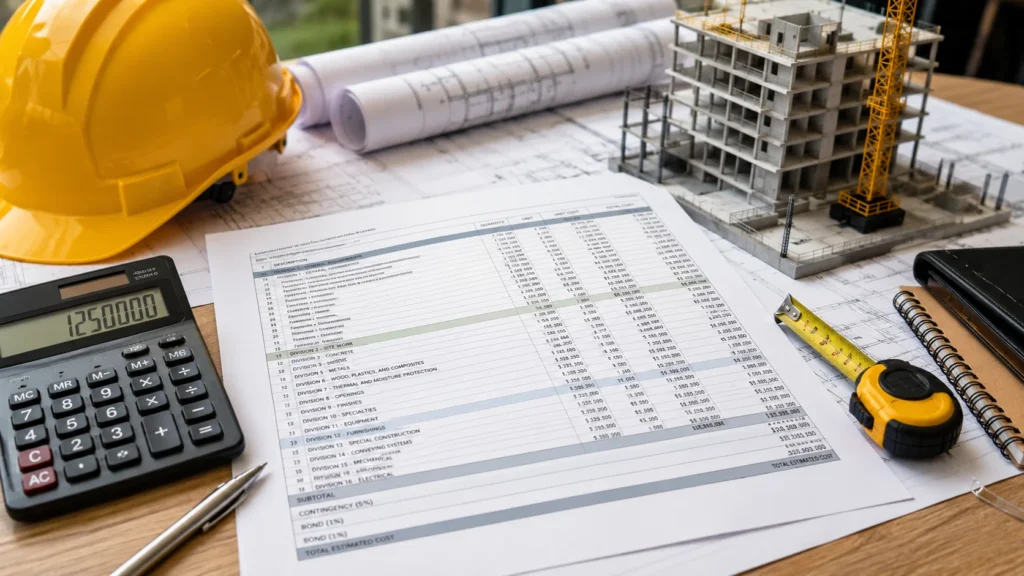
A detailed estimate is the most accurate type of estimate that can be used in bidding for a construction project. This is an estimate compiled based on full project drawings and specifications and scope documents. Contains precise amounts of materials, labor, equipment, subcontractor, overhead and profit.
The detailed estimate is the most accurate estimate that is available because a lot of the project’s actual data is used rather than being assumed. It is the approach taken by contractors to prepare a Construction bid estimate before entering into competitive bidding.
What Are the Main Types of Construction Estimates
There are various kinds of estimates in the construction industry at various stages of a construction project. A glimmer of each of them:
Rough Order of Magnitude Estimate
This is the oldest and most obsolete one. Use when a project is in its initial stages. It provides an approximate value, which can be as much as 25-50 percent off. It gives clients a sense of where the project fits in their decision-making process, but would not be used to submit a formal bid.
Preliminary or Conceptual Estimate
This occurs when there is certain design information. More sophisticated than a ROM, but still using a lot of historical data and costs per square foot. The accuracy is about plus or minus 15–20 percent. Instill a snug fit in a competitive bid.
Design Development Estimate
This estimate is based on some sketches. As more details of the project are known, it becomes more and more restrictive. Sometimes, contractors use this for the initial budget discussions but the drawings are not detailed enough to give a good estimate.
Detailed or Definitive Estimate
This is the criterion that must be met. This is the most precise form of construction bid estimate that you can create. Constructed by using full drawings and specifications. All materials are counted! All labour hours are calculated. All of the subcontractor scopes are priced. The margin of error, or range of error, ranges between 5% and 10%.
Why the Detailed Estimate Wins for Bidding
In the construction bidding phase, the only estimate that can give you confidence is a detailed estimate when you’re bidding for a construction contract. Here are some of its distinguishing features.
It takes off completely on full quantity takeoff. Each and every unit of this project, whether it be a yard of concrete, a sheet of drywall, or a linear foot of pipe.Each and every unit of material in the project, whether it be a yard of concrete, a sheet of drywall, linear foot of pipe. No guesswork and assumptions are made when estimating. This eliminates a huge source of error from your construction bid estimate.
It doesn’t take into account the true rates of labour. A detailed estimate is one that separates the labour into trades and tasks. Your crew rates and your local labor market costs are the actual crew rates, and your productivity information. This means that your price is a true price from the real world, not just a number out of a database.
It distinguishes between the direct and indirect costs. Direct costs are the expenses for materials and labour. Overhead project management insurance and bond fees are included under the indirect costs. A detailed construction bid estimate captures both so that you do not miss out on any money in your bid.
The Role of Software in Building Accurate Estimates
This can be done by hand and will take time, but it will introduce some human error. The reason behind which the majority of contractors use estimating software to construct their estimates today.
Software like Sage construction estimating can assist groups in arranging takeoffs, applying cost databases to and creating detailed estimates more quickly and precisely. Sage merges estimate and accounting so your estimate is directly related to your job costs. This not only allows you to track actual spend to estimate spend in real time, but it also enables your team to monitor actual costs against the estimated costs.
Other platforms also enable teams to simplify the construction bidding process; they store information about previous jobs, and your next estimate will be more accurate, based on what you’ve experienced in the past.
What Goes Into a Detailed Construction Cost Estimate
All of the following are elements of a good construction cost estimate at the bid stage.
- Quantity Takeoff: An entire material list extracted from the last drawings. No guessing. No rocket surges. No massively rounded up. An accurate number of each item.
- Labor Costs: Hours worked x fully loaded labor rates (fully loaded rates are the hourly cost of labor, including taxes and benefits).
- Material Costs: Up-to-date material prices from suppliers, rather than from an outdated database. In a fast-moving market today, it is important to have up-to-the-minute quotes.
- Equipment Costs: Depreciation of owned equipment or rental fees for equipment the project needs that is not owned.
- Subcontractor Pricing: Bids received from subs for work that you don’t perform.
- General Conditions: Job Site Trailer, Safety Signage, Site supervision and Site overheads which are directly related to the project.
- Markup: Profit margin + company overheads based on the cost. That’s where it is business and field.
- Each layer is built up on the previous layer. A single already created and your construction bid estimate will start a hole that you may not realize until the work begins.
Conclusion
The detailed/delineated estimate is the most accurate estimate to use when bidding on a construction project. It is based on total information real quantities and the existing price. It includes all cost layers like raw material cost, overhead cost etc.
When it comes to the construction bidding process, then preparation is rewarded. Contractors who put considerable time into a detailed cost estimate are winning quotes for work that will enable them to maintain their margins. But if someone guesses and skips through the estimate, they are likely to discover the hard way that having a low bid translates to a loss on the job.
Re-create your construction bid estimate in the correct manner, complete take-offs, correct labor rates, fresh material pricing and proper tools that will aid your team. That’s the way to get jobs and to earn some cash.