
You enjoy a comfortable temperature in your home, but few homeowners understand the technology that produces it with their air conditioner. Two key elements are essential to this cooling process that go hand-in-hand, and that is the indoor evaporator coil and the outdoor condenser coil. They may seem alike, and both have the same end goal, but their daily work is decidedly different. One sucks up the oppressive heat and keeps it inside your home and the other sends it out into the fresh air. When these components do not work together properly, the system will not run efficiently, fail unexpectedly and result in huge repair costs. To preserve your HVAC investment, this quick guide explains the key mechanics of an evaporator coil vs condenser coil.
What is an AC Evaporator Coil?
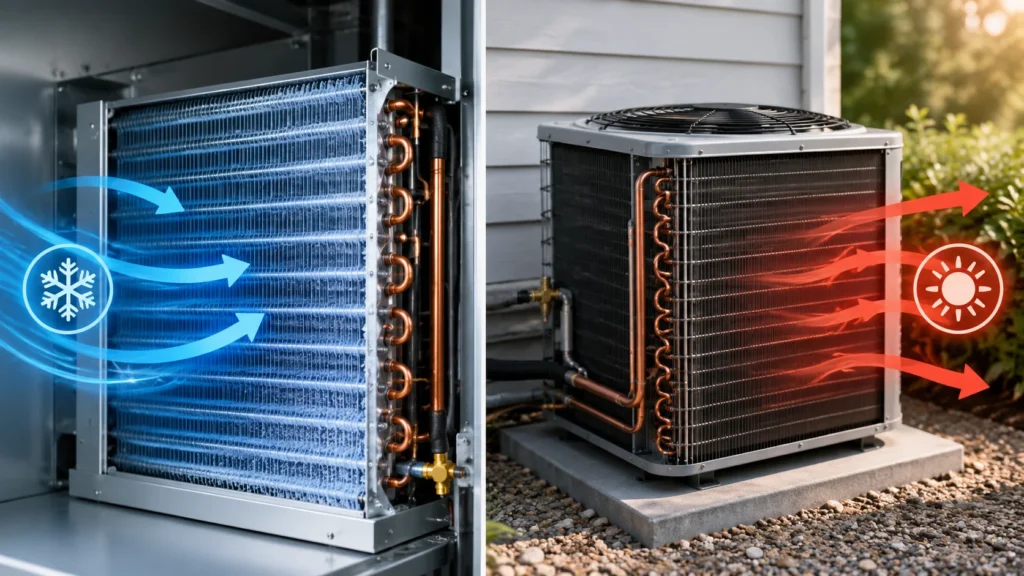
The evaporator coil is inside the indoor HVAC system. It consists of a series of copper or aluminium tubes which serve to remove the heat from the air inside your house. The warm air as it comes in contact with the coil, puts the liquid refrigerant into a boil. The liquid refrigerant boils when the warm air comes in contact with the coil. This will lower the temperature in the air instantly and your system will blow the cooled air back up through your vents to lower the temperature in your rooms.
What does Condenser Coil mean?
The condenser coil is located on the exterior of the AC unit and it performs its task in reverse. It expels the heat inside and releases it outdoors. The refrigerant enters this outdoor coil as a hot and high-temperature gas. These coils are made with a large fan blowing outside air across them and the heat dissipates into the air. When it cools down and condenses back to a liquid, the refrigerant is ready to go through the cycle again.
Why Understanding Evaporator Coil vs Condenser Coil Matters
How to know the difference between evaporator coils and condenser coils? If you’re considering maintenance or budgeting for repairs on your system, you need to understand the difference between the condenser coil vs evaporator coil to avoid being ripped off.
Both these are to be kept very clean. Household dust or pet dander on the coil in the indoor unit will prevent it from absorbing heat efficiently. The coil becomes so cold that it turns into an ice block.
When outdoor condenser coils become dirty with grass clippings, dirt or fallen leaves, they are unable to release the heat. The system must run twice as long and use the expensive compressor motor.
How They Work Together to Cool Your Home
Imagine these 2 coils as a relay team with copper relay wires instead. The process starts when liquid refrigerant enters the indoor evaporator coil. The coil absorbs heat and clinging moisture as the air is circulated through the house. When the air is circulated inside the house, the coil pulls out heat and sticky humidity. The moisture is trapped on the cold metal and passes safely to a drain pan which leaves your air crisp and dry.
The gaseous refrigerant is now hot and moves outside to the condenser coil. The heat from the outdoor unit is released into the atmosphere, causing the refrigerant to condense back into a liquid. This is then pumped back into your home again and repeats itself to maintain a comfortable environment in your home.
The Cost of Coil Replacement
Replacing an HVAC coil is a significant investment. Below is the cost breakdown for both evaporator and condenser coils, categorised by system type, unit size, and replacement scope.
| Replacement Type | Category / System Size | Average Cost Range |
| Evaporator Coil (Indoor) | Standard Systems | $600 – $3,700 |
| Mini-Split Systems | $1,900 – $2,300 | |
| Heat Pump Systems | $2,100 – $2,500 | |
| 1.5 – 2 Ton System | $600 – $1,400 | |
| 3 Ton System | $800 – $1,800 | |
| 4 – 5 Ton System | $1,600 – $2,400 | |
| Condenser Coil (Outdoor) | Coil Replacement Only | $900 – $2,300 |
| Complete Condenser Unit | $1,200 – $4,200 |
Conclusion
Without both the evaporator coil vs condenser coil working in perfect harmony, your AC simply can’t operate. One controls the heat rejection on the outside and the other the heat removal on the inside. If one coil fails, your whole system takes a hit, which is why it can cost a lot to replace them when the price is as it is.
The easiest way to avoid expensive energy bills and breakdowns is to keep these coils clean and well-maintained. Assuring your system’s health helps maintain your comfort and helps keep you budget-friendly. If you see there’s a problem with the air flow, or if it makes an unusual noise, solve the issue early on, before it becomes a big and expensive problem.
Are you planning to construct or renovate your building? So, go to our main site at Fusion Estimating and let us help you draw up the ideal financial plan before you begin purchasing parts!