
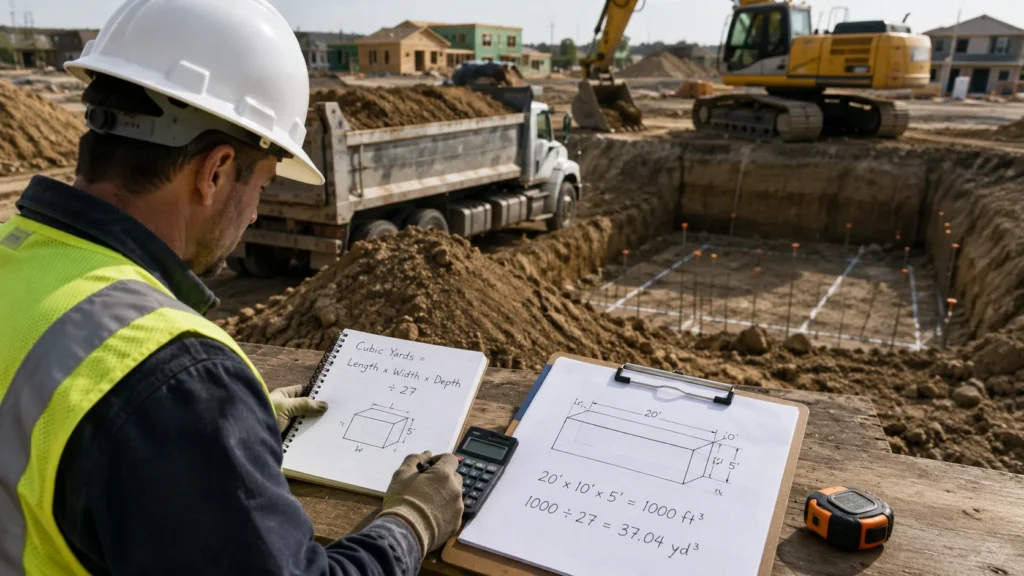
To estimate cubic yards for construction, multiply length, width, and depth in feet and then divide by 27. This formula will convert cubic feet to cubic yards, which is the standard for bulk materials used in the industry. Remember to change any depth from inches to feet before you use it, by dividing by 12. For example, 0.33 feet is equal to four inches of depth. Material shortages and costly delivery re-orders are avoided with accurate calculations. Allow a ten percent waste allowance for concrete, gravel or soil to allow for compaction, spills and ground level unevenness. Round up to make sure that you have enough material to finish cleanly.
What Even Is a Cubic Yard?
Visualize a box 3 ft. long, 3 ft. wide and 3 ft. high. That’s one cubic yard in the box. It is equal to 27 cubic feet. That’s it. Easy but requires proper usage every time! On a construction site, concrete, gravel, topsoil, sand, mulch and most other bulk materials are measured in cubic yards. Material will be quoted by the supplier by the cubic yard.
The Formula for Estimating Cubic Yards
Here’s the formula for figuring cubic yards for any rectangular or square space:
Cubic Yards = (Length × Width × Height) ÷ 27
Here’s the formula for figuring cubic yards for any rectangular or square space:
Cubic yards = length x width x height / 27
Before dividing by 27, all measurements must be in feet. That is what everyone forgets. If a measurement is given in inches, first convert it to feet. 6 inches is equal to 0.5 feet. Four inches is equal to 0.33 feet.
However, for your example, you are pouring a 12′ x 10′ x 4″ concrete slab.
- Convert 4 inches to feet: 4 ÷ 12 = 0.33 feet
- Multiply: 12 × 10 × 0.33 = 39.6 cubic feet
- Divide by 27: 39.6 ÷ 27 = 1.47 cubic yards
That’s how to figure cubic yards for the simple flat slab. Use the same formula for footings, gravel beds, soil fills, etc., with a length, width, and depth.
How to Master Estimating Cubic Yards for Different Project Situations
When your space isn’t a perfect rectangle, calculating cubic yards becomes a little bit more complex. These are the most frequent and how to deal with them.
Irregular areas: Divide the area into smaller rectangular spaces. Work out each part (the first part, the second part, etc.) and then sum them up.
Circular areas such as a round pool base or column footing: Volume = π × (radius)² × (depth). Next, divide by 27 to obtain cubic yards.
Trenches and footings: Take measurements of the length, width and depth of each trench run. If the trench is not uniform in depth, divide it up into sections and calculate each section.
The rule remains the same: the bigger the square, the more weight it will bear. Measure all dimensions in feet, multiply length, width and height, then divide by 27. The more you do estimating cubic yards, the quicker you’ll get it!
Common Materials Where This Comes Up
Concrete: It is important to have an exact number of cubic yards before the truck leaves the plant. Order a short with a pour that stops and it is done. When ordering too much, you are wasting money.
Gravel and Base Material: Typically, you are ordering by cubic yards for driveways, parking lots or sub-base material. A parking pad is a 20×50-foot pad, under which is a 4-inch gravel base, which equals approximately 12.3 cubic yards.
Topsoil and fill dirt: It is important to know how to measure cubic yards accurately when laying topsoil, grading and preparing a site.
Excavation: If you are digging an excavation such as a foundation or a utility trench, you must be aware of the amount of material that you are removing. This will give you an idea of the number of trucks you will need and the cost of hauling.
Why Accurate Estimating Cubic Yards Saves You Real Money
This is where estimating cubic yards becomes more than just math; it’s project management. If your numbers are incorrect, you have two problems. First, over-ordering. Extra material is an expense, an issue of space and possibly a disposal issue. Concrete that is left in the truck is not a free good.
Second, under-ordering. If you run out mid-pour or mid-fill, you will incur delays, extra delivery costs and potentially poor quality work if the material sets before you are through. Accurate cubic yard estimates help you stay on budget and on schedule with your work crew.
When to Use Professional Construction Take-Off Services
It’s time-consuming, prone to mistakes and not feasible for doing by hand if you’re working on a larger project, a commercial build, a multi-phase development, or anything with multiple material types or complex shapes. This is where the Construction Take Off Services fit in.
Rather than the concrete or fill quantity, a professional takeoff provides you with the precise quantities for each part of the project. It takes into consideration waste factors, compaction rates, and site-specific factors that are not simply captured by a formula alone. We do the numbers at Fusion Estimating, so your team can do the work. From estimating cubic yards for one pour to a complete material take-off for a large site, we stand behind every number.
Conclusion
In the end, it is a matter of slowing down, looking at the units and remembering the magic number 27. After mastering the process of converting inches to feet the first time, you may find yourself estimating cubic yards the next time you’re on the jobsite. It ensures that you’re not wasting money on additional delivery charges or excess concrete, keeps schedules on track, and safeguards your profits.
Whether you find yourself late at night hunched over blueprints or afraid that you’re leaving out a key piece of information in your offers, you can put that burden on us. With the insider expertise and experience in estimating, our expert Construction Take Off Services in the US provide you with accurate, field-ready material counts to ensure you have complete confidence in your bids and secure better work opportunities. Looking to simplify an upcoming project? Call us today and let’s work together!