
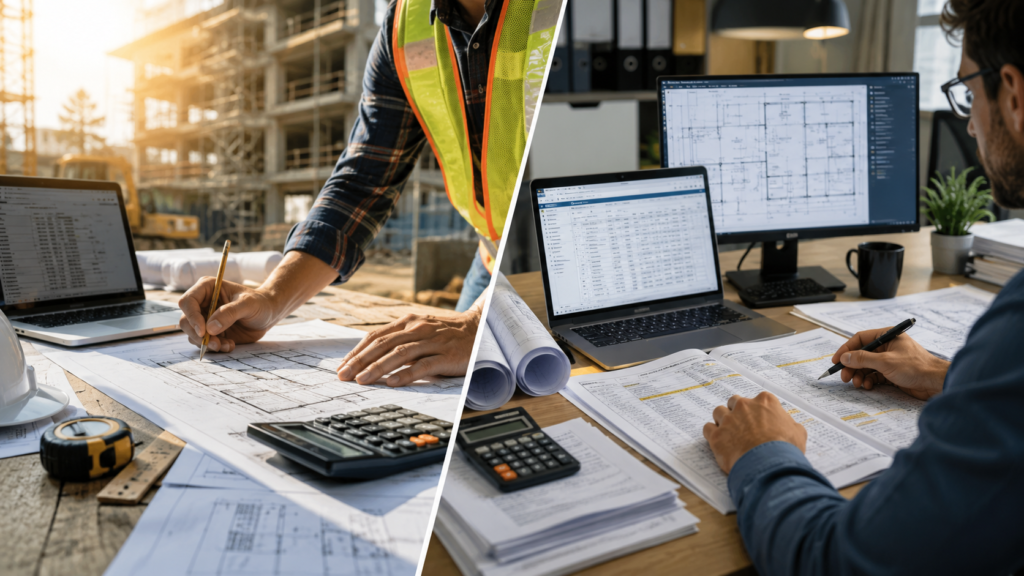
In the building business, accuracy is the distinction between a flourishing organization and one that goes bankrupt. Beware of bidding too high; otherwise you will lose the job to someone else. If one bids too low, it can be a disastrous loss of profits during execution.
Traditionally, contractors have used full-time, salaried employees to maintain the right balance. With rising overheads and difficulty sourcing and retaining skilled labor, however, a critical discussion has arisen about outsourced construction estimating.
For today’s contractors, it is critical to recognize which model will yield greater savings and success. Let’s examine the finances of both to see which will pay off more.
The True Cost of an In-House Estimator
Many contractors think the best course of action is to have estimation done in-house. They work for you exclusively and the logic is sound, because you pay them a certain salary. However, the cost of in-house estimator recruiting is much more than a simple paycheck.
With a full-time employee comes a lot of fixed overhead. In the industry, it is not uncommon for total employment costs to be 1.25-1.4 times the base salary. That means that in practice, they look like this:
- Salaries and Benefits: A construction estimator with the experience and expertise is worth higher pay. In addition, an employer is required to offer health insurance, retirement and sick leave.
- Software Licenses: A specialized software program, such as Planswift, Bluebeam or RSMeans, is needed for modern estimating. These subscription fees are in the 4000$ per seat per year range.
- Office space and hardware: Office space and high-end computers and monitors and office supplies are all a monthly drain.
- Seasonality: Construction work is bound to be seasonal. When the company isn’t busy, an in-house estimator receives a full paycheck even if there is no bidding activity. You’re paying for a time you aren’t working.
These costs, in total, can make a single in-house estimator very expensive to a business, ranging from $100,000 to $150,000 a year, no matter how many bids he or she submits.
The Rise of Outsourced Construction Estimating
In order to reduce these “built-in” expenses, many companies are now opting for outsourced construction estimating. Rather than being a fixed monthly expense, contractors view estimating as an expendable service and tailor their needs to the volume of work on the projects they are working on.
Contractors work with professional construction estimating services and gain access to an entire team of specialist estimators when they need to. This transformation has a significant impact on the financial dynamics of a construction company. You are only charged for the results, e.g., material takeoffs, line-item pricing and bid formatting.
Comparing the Real Overhead Numbers Side by Side
Let’s compare the capital outlay and capital costs of both models and see which will save the most money in some of the major aspects of operation.
| Expense Category | In-House Estimator | Outsourced Estimating |
| Payment Structure | Fixed monthly salary + benefits | Variable fee per project or hourly rate |
| Software & Tech | Fully funded by the contractor | Included in the service provider’s fee |
| Scalability | Limited by individual capacity | Virtually unlimited; teams scale as needed |
| Slow Season Cost | High (Paid regardless of workload) | Zero ($0 spent when not bidding) |
| Onboarding & Training | Costly and time-consuming | Immediate deployment |
What Are Core Benefits of Outsourced Construction Estimating
Deciding to outsource isn’t simply about reducing your overheads; it’s about ushering in a stream of operational benefits that can have a tangible impact on your winnings.
Eliminating Fixed Overhead
The most obvious savings are the change of a high fixed cost to a variable, flexible cost. When the market takes a turn for the worse or when you choose not to bid for a while but concentrate on executing a project, your estimating cost becomes zero.
Access to Specialized Expertise
One estimator within the company could be amazing at drywall for commercial buildings, but not so great at a complex civil engineering plan. With the use of outsourced construction estimating, you don’t simply hire one person. You’re utilizing a network of professionals. For mechanical bids, electrical bids, plumbing bids, or structural bids, professional firms can have their own experts who will perform hyper-accurate material takeoffs.
Advanced Technology Without the Bill
Yet it takes huge capital investments and continuous training to have first-rate construction estimating software. By outsourcing, you get the benefits of using cutting-edge technology without a lot of software licenses, software updates or IT support costs.
Speed and Scalability
If there is a rush of Requests for Proposals arriving at your desk at the same time, then there’s a single employee who becomes a troublemaker. They either hurry bids which result in costly calculation errors or they miss out on lucrative opportunities. Construction takeoff services keep the staffing level necessary to cope with unanticipated spikes in volume, so you can bid on more projects at once.
What About Hiring a Freelance Estimator
As a middle ground, some contractors consider hiring a freelance estimator via online marketplaces. This may be less expensive than employing a full-time worker, but there are risks involved that have long-term consequences that can cost you more.
Freelancers usually work in isolation, which means that they have the same capacity restrictions as an in-house employee. Should they fall ill or make a big mistake in their quantity take off, there’s little you can do.
By contrast, a trusted outsourcing firm has internal quality control systems, reviews and accountability measures that freelancers can’t replicate.
How to Get the Best Return on Your Investment
To be certain outsourced construction estimating is actually saving your business money, you will have to do it strategically. It isn’t a matter of completely handing over your keys; it is a true partnership.
- Give Historical Data: Share your historical project data and actual labor costs with your outsourcing partner. This enables them to tailor the estimates to your company’s actual performance, instead of just national averages.
- Treat Them as an extension of your team. Establish a streamlined communication channel. Don’t forget to be responsive to questions that they ask pre-bid; the closer their submittal will be to the correct answer.
- Before Submitting: Review your bids carefully. Take the time during the takeoff to make a thorough analysis of the margins, risk factors and project constraints.
Final Verdict
In most cases, outsourced construction estimating is much more cost-effective and profitable to small to mid-sized contracting companies than bringing on a construction estimator.
You reduce the overheads of having a person on staff working as an estimator, paying their salary and benefits and keeping them warm while waiting to be productive. You remove the hard cost of working an estimator on salary, benefits and waiting for them to be productive and you protect your business from market fluctuations. You are able to bid vigorously when the market is hot and to recede safely when it cools without any additional overhead and with bids that are pretty close to the mark.
You will have an edge in your business if you save money during the bid procedure and then win the job and do it profitably.