
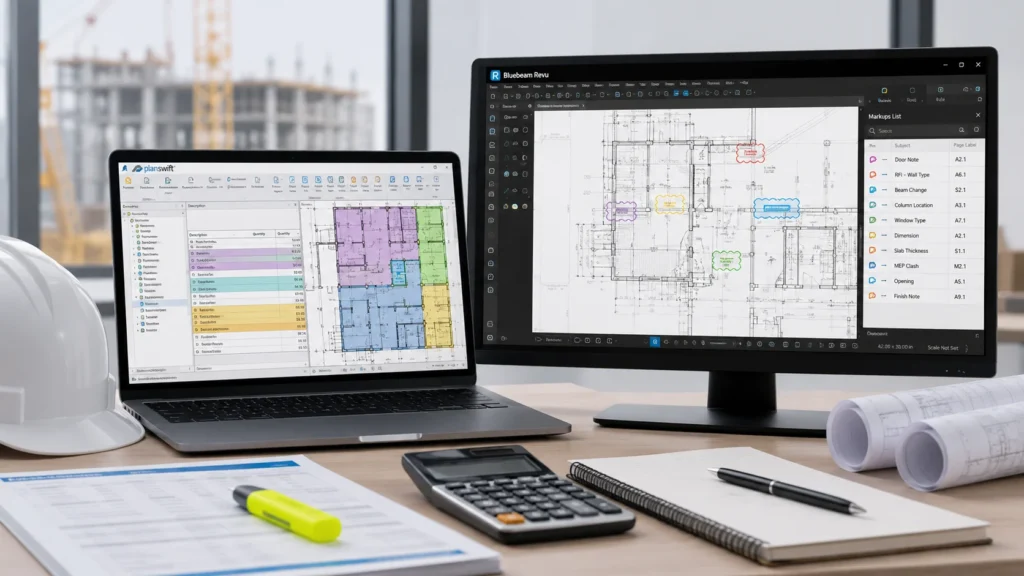
With the commercial and residential construction industry’s hectic pace, the bidding process is a race against time and it’s a serious matter. We’ve all been in the situation before, where contractors spend days manually climbing ladders to scale paper blueprints, mark up architectural drawings with colored markers and then cross-reference all the data in huge spreadsheets, only to have to submit a single proposal. This is the traditional way, which takes a long time, is cumbersome and can lead to catastrophic human error.
In an effort to keep up to date with the competition, smart companies are replacing their scale rulers and highlighters with newer tools. It’s no longer a luxury but a necessity to implement construction estimating software. Digital platforms can speed up the time needed to create proposals that contain accurate quantities by automating quantity takeoff, connecting the amount to live databases of material costs and enabling teams to collaborate.
PlanSwift and Bluebeam are the two major players in this field. Both these digital takeoff tools contractors use daily, but take a completely different approach to the preconstruction process.
This complete overview of the essential construction estimating software benefits and in-depth PlanSwift vs Bluebeam comparison will give you the information you need to choose which is the best construction takeoff software to support your takeoff workflow.
Why Traditional Bidding Fails In Construction
It’s important to first grasp why conventional bidding processes are inadequate before considering the possibilities of software to speed up the process.
Manual estimation involves printing large-scale blueprints, accurately estimating linear distances, estimating square footage for areas and counting each fixture, door or electrical outlet individually. There are high risks with this method:
- The Velocity Problem: Manual takeoffs require a lot of time so that a contractor is able to take on only some amount of projects each month. With a 15% win rate, it’s necessary to massage a lot of bids in the pipeline. Manual processes limit the amount of money you can make.
- The $100,000 mistake: If you miss one note or make a mistake on a scale on a 60-sheet set, you run the risk of underbidding, thus losing profit before your first shovel hits the ground.
- The Revision Nightmare: When architects issue addenda and design revisions late in the bidding phase, manual estimators must restart their measurements from scratch, creating a massive bottleneck.
Modern construction estimating software eliminates these vulnerabilities altogether by completing the transition of the workspace and automating repetitive math.
What 5 Ways Construction Estimating Software Speeds Up Bidding
A dedicated digital platform is the first step to transforming the estimator’s job from data entry to strategic risk management. Specialized software can revolutionize the preconstruction process in the following ways:
1. One-Pass Multi-Trade Measurements
Using the traditional method, one has to make several passes to calculate the materials of a single room. The perimeter for baseboards, the height of the walls for drywall and paint and the area of the floor for carpet need to be measured by an estimator.
Digital takeoff tools for contractors are available now and offer the ability to do “one-pass” geometry. The software is able to trace a room once and extract the area, perimeter and volume at the same time. This one feature reduces measurement times by up to 70%.
3. Gateways for accessing the data
It’s a waste of an estimator’s time to have to manually scan dozens of sheets to count the plumbing fixtures, light switches or doors on each one. There are pattern-recognition algorithms that are provided when it comes to advanced “best construction takeoff services” With the single symbol selection, the platform automatically scans all the document sets and provides an accurate count of the symbols within seconds.
3. Visual Revision Overlays (Slip-Sheeting)
It is very difficult to determine by visual inspection what has been changed when an architect issues a revised drawing set. Digital overlays are the solution to this problem with construction estimating software. Adding new walls, removing fixtures, or moving dimensions will instantly be noticeable because the old drawing template is stacked over the new template in contrasting colors (e.g. red and green).
4. Dynamic Material Assemblies
Rather than just measuring a line and applying a cost to it in Excel, there are specialized estimation tools that use ‘assemblies’. For instance, if a drywall installer traces a 10-foot linear wall, the software automatically calculates how many metal studs, drywall sheets, screws, tape, drywall compound and labor hours are needed for the job, depending on its pre-programmed formulas.
5. Standardised Templates for Bid Consistency
The quickest estimators do not click the quickest; they have “standardized” their operations. Estimators can repeat layouts of identical hotel rooms, school classrooms, etc., using custom templates, eliminating the need to measure each room.
PlanSwift vs Bluebeam Comparing Features Accuracy and Value
There are a number of specialized platforms on the market, but PlanSwift and Bluebeam Revu are the best platforms for professionals looking for the best construction takeoff software. They do have different chief purposes, though.
| Feature / Attribute | PlanSwift | Bluebeam Revu |
| Primary Design Philosophy | Takeoff-First & Direct Cost Estimation | Document Management & Collaboration |
| Core Strengths | Drag-and-drop assemblies, automatic material formulas, trade-specific logic. | Advanced PDF editing, real-time collaboration (Studio), multi-page markups. |
| Ideal User Profile | Subcontractors (Drywall, Flooring, Framing, Roofing, Concrete). | General Contractors, Architects, Engineers, Project Managers. |
| Data Output | Built-in cost estimating screens, seamless native Excel exports. | Customizable markup legends, CSV summary reports, XML exports. |
| Learning Curve | Low to moderate for pure quantity takeoff work. | Moderate to high due to the extensive document management feature set. |
PlanSwift: The Quantity Takeoff Specialist
PlanSwift is designed to handle quantity take-offs and generate costs in real-time. It is extremely intuitive to use and includes a “point and click” and “drag and drop” interface, making it easy for estimators to get in, measure, price and get out.
It comes with a number of benefits, the best of which is its advanced assembly creation. PlanSwift enables you to create very complicated, complex, nested formulas. PlanSwift not only tells the concrete contractor how many square feet he has, but it also tells him how many cubic yards of concrete that will require, how many tons of rebar, how many square feet of vapor barrier and how much labor it will take!
It is one of the most effective construction estimating software options for the specialized subcontractors that require ultra-precise bills of materials BOMs in a fast-paced manner.
Bluebeam Revu: The Project Collaboration Powerhouse
Where PlanSwift focuses heavily on the math, Bluebeam focuses on the document workflow. Bluebeam Revu is a robust PDF editing and markup platform that features incredibly accurate, built-in measurement tools.
Bluebeam’s true superpower is Bluebeam Studio, a cloud-based ecosystem where multiple stakeholders can view, mark up and measure the exact same drawing set simultaneously in real time.
For a General Contractor coordinating bids across ten different trades, Bluebeam is unmatched. It allows the team to manage RFIs, track submittals, hyper-link multi-page drawing sets and manage visual punch lists. While it requires a bit more manual setup to link measurements to exact dollar values compared to PlanSwift, its versatility across the entire life cycle of a project makes it indispensable for management teams.
How to Choose Your Workflow Between These Two
It’s a choice between these two giants that depends on your position in the preconstruction world:
Use PlanSwift when: You are a trade subcontractor who struggles to count materials, calculate specific mixture volumes and convert dimensional measurements into specific material costs in a flash.
Use Bluebeam when: Coordination with multiple trades is required, you are communicating with architects and clients on a regular basis, document control is crucial and the project management function is needed past the time of the win.
Pro-Tip: A lot of construction companies that are very successful do not restrict themselves just to one or the other. They employ both together, leveraging the dedicated PlanSwift deep quantity takeoff engine and drawing management, team communications and client presentation software, Bluebeam.
Conclusion
The bottom line of bidding in today’s building is a numbers game. The better your estimates are, the more profitable jobs you will get with your firm. Using paper blueprints and manual scaling greatly restricts your business’s capacity to operate and opens the door to costly estimating mistakes.
By investing in the best construction estimating software, you can save half the time you spend taking off, have your bid templates standardized and save precious time to concentrate on strategic pricing, risk allocation and vendor negotiations. No matter which of these laser-like takeoff speeds you choose, PlanSwift or Bluebeam’s collaborative capabilities, updating to digital workflows means your team can bid confidently, accurately and quickly.
Next Step for Your Business: Take a look at your existing preconstruction process. Do your estimators spend more time doing simple arithmetic or working out the risks on your project? Download a free trial of these digital instruments today and find out what this contemporary automation can do for your win rate.