
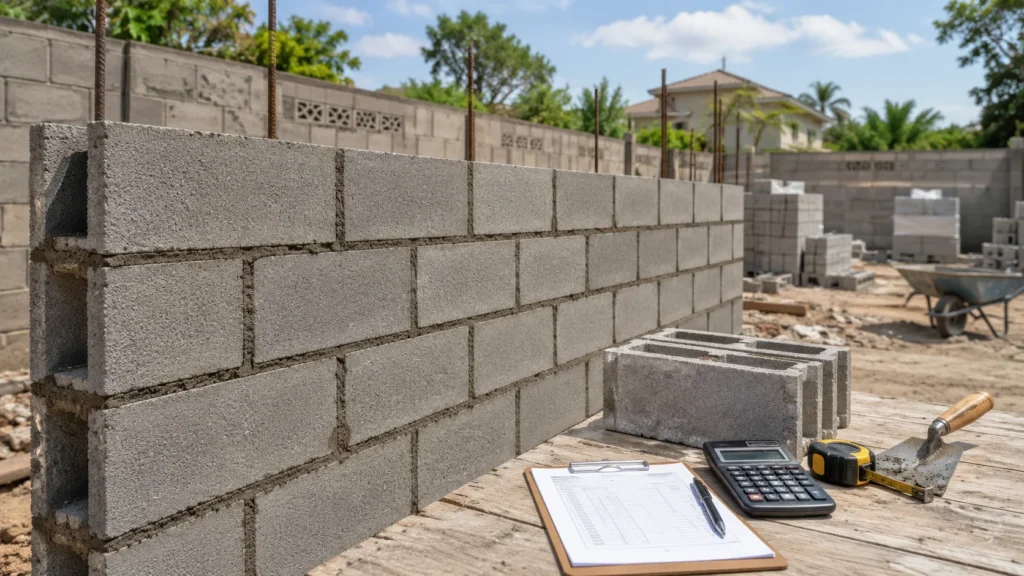
The national average cost of the installation of a standard wall in 2026 is in the range of $15 to $30 per square foot. Alternatively, if you want to see it in terms of linear feet, you can expect anywhere from $60 to $240 per linear foot, again, depending on how high you need your wall to be. Homeowners typically invest $1,500 to $6,000 for the total costs of a 25-foot-long wall in their homes.
It’s always worth going through each expense line individually before you begin to dig trenches or place online orders for materials. Let’s examine the cinder block wall construction costs, the labour, and why you need the budget to be spot on.
What Are You Actually Paying Per Block?
To help you digest, we have broken down the common costs you will be faced with for a typical cinder block wall construction project.
| Expense Category | Estimated Cost (Low to High Range) | Pricing Basis |
| Standard Gray Block Materials | $1.00 – $3.00 | Per Unit / Block |
| Decorative / Split-Face Blocks | $3.00 – $8.00 | Per Unit / Block |
| Masons & Labor Fees | $35 – $100 / $10 – $17 | Per Hour / Per Sq. Ft. |
| Concrete Footing Foundation | $8 – $15 | Per Linear Foot |
| Rebar & Wet Core Grouting | $2 – $4 | Per Linear Foot |
| Stucco or Paint Finish | $2 – $17 | Per Square Foot |
How Many Blocks Do You Actually Need?
One simple formula to remember is length x width = square footage. Divide by 0.9 (the coverage area of a typical block with the mortar joints). Add 5%-10% for cuts and waste.
About 110 blocks are required to make a 100 sq. ft. wall. About 555 blocks are required for a 500 sq. ft. wall. The wrong number will result in over ordering or running a low mid-job, which is costly.
Cinder Block Wall Construction Material Costs
People can confuse the terms of masonry blocks. The difference in history exists between a concrete block and a cinder block, but most professionals these days use the terms interchangeably when referring to standard Concrete Masonry Units (CMUs). The real vintage cinder block wall construction was created utilizing coal ash, which was lighter yet less sturdy. Today, it’s made of a dense, durable concrete that can support a building’s heavy loads.
The price of standard gray CMU blocks is approximately $1.00 to $3.00 for a basic project. For any decorative styles or even split-face blocks to create a textured stone-like look, prices increase to $3.00 to $8.00 per block.
Your material budget is also determined by the size. Most home construction jobs employ 8″ x 8″ x 16″ cinder blocks. These standard units weigh about 30 to 35 lbs per unit. Depending on your design, your price per unit will vary if you are using either thinner 4″ blocks or thicker 12″ blocks. You do save money by buying in bulk, and by buying a full pallet (90 to 120 blocks), you will usually save 20% or more than the cost of an individual block.
Labor and Installation Fees of cinder block wall construction
Cinder block wall construction is not a project for the weekend, unless you’ve got a very strong back and many years of experience running a trowel. It’s pretty technical work.
Qualified masonry contractors charge between $35 and $100 per hour or about $10 – $17 per square foot. If one examines the speed of the work, which is about $5 to $10 per block, as a physical matter, one finds that masons earn at this rate.
What is the reason for this expensive labor? As the old saying goes, a wall is only as strong as its foundation. The cost of a poured concrete footing must be added to any structural wall. The cost of digging a trench, installing forms and pouring a solid concrete foundation is $8 to $15 per linear foot. When your wall is tall or the wall serves as a retaining wall, foundation requirements may be increased in depth and foundation costs can go up to $25 per linear foot easily.
Real-World Cost Breakdown by Project Type
There are different types of walls. Your cinder block wall construction can significantly affect your invoice. The following is a breakdown of the expected cost of energy for each typical household use in 2026:
- Property Line Fences ($15 – $30 per sq. ft.): Ideal for privacy and security. Most local city codes only allow a wall to be 4 feet high in the front yard and 6-8 feet high in the back yard.
- Retaining Walls ($20 – $35 per sq. ft.): These require extra engineered strength. You also need to include the cost of backfill gravel and any specialty drainage pipes on the back of the wall, in addition to the original price, to ensure that water pressure does not cause the masonry to collapse, which is anywhere between $5 and $15 per linear foot.
- Garage & Shed Walls ($10 – $35 per sq. ft.): Detached construction in block is an excellent fire and storm protection solution, but the cost rises significantly if insulation or exterior stucco finishes are applied.
Key Advantages of cinder block wall construction
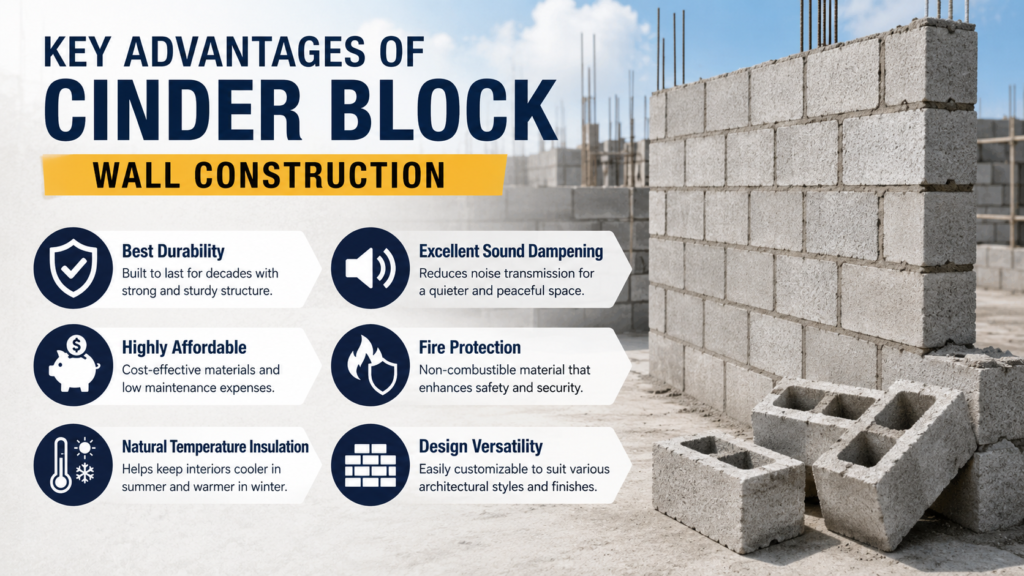
Masonry has been with us for a reason. If you select cinder block wall construction, you are putting your money into a wall that will stand the test of time. This material is still a preferred choice for new homes and offices for these reasons:
Best Durability
No other common material can be as strong as a concrete block. In contrast to wood or lightweight framing, masonry holds up to high impacts, extreme weather and natural disasters. The life of a properly installed wall is almost 50 years with minimal maintenance.
Highly Affordable
The blocks have a much lower cost per square foot than natural stone or brickwork. They deliver quality structural strength without a price tag that’s too exorbitant for raw material or installation expenses.
Natural Temperature Insulation
Cinder blocks are great thermal mass! They help maintain an interior temperature throughout the year, relieving your heating and cooling systems – and your energy bills.
Excellent Sound Dampening
The blocks are dense and heavy which means they will naturally block noise coming from outside the room. This makes it much quieter and more private inside your home or in your backyard.
Fire Protection
Concrete is totally non-combustible. When it comes to building with blocks, you always have a huge safety layer that can shield your property from fire.
Design Versatility
Don’t think blocks are boring! They are manufactured in standard sizes which facilitates quick installation, but can also be painted, stuccoed or finished with custom textures to complement any architectural style.
Common Types of Cinder Block Wall Construction
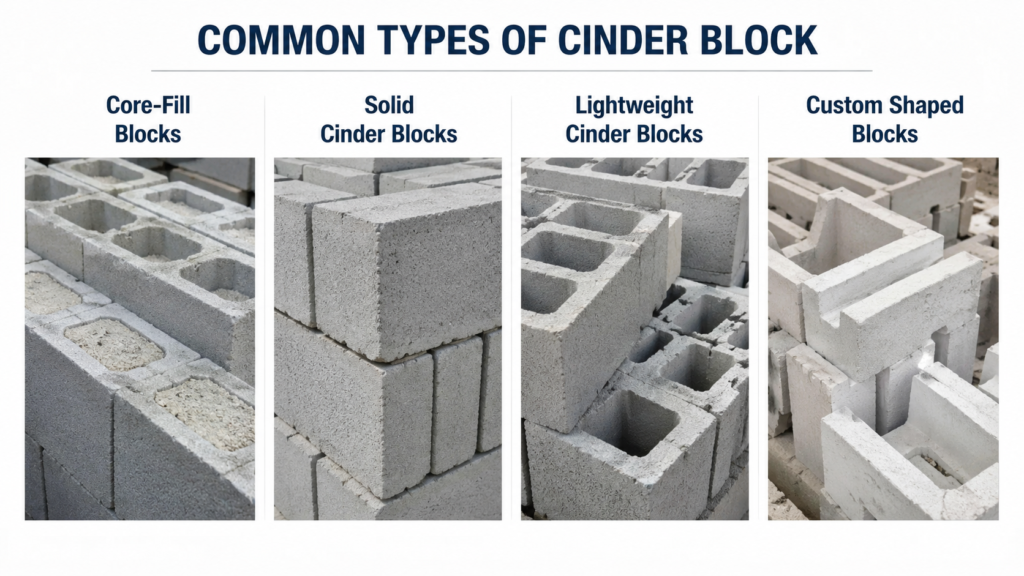
The selection of the right block is entirely dependent on the type of project, climate and budget of the applicant. There are various types of cinder block wall construction, which are classified according to their weight, structure and appearance.
Core-Fill Blocks
These are the basic blocks that you use for everyday and general-purpose applications with hollow cores. Most load-bearing walls and partitions rely on them as the main foundation, as the cores can be easily made stronger with steel rebar and concrete.
Solid Cinder Blocks
Blocks that have no hollow cores. They are very weighty and sturdy buildings, built to carry as much weight as possible. These are normally found in foundations or in a large retaining wall.
Lightweight Cinder Blocks
These are the ones that are made up of lighter aggregates; they are easier to handle and can be installed rapidly. Best suited for non-load-bearing applications such as a simple garden wall or a privacy fence, where strength is not as critical.
Custom Shaped Blocks
These blocks come in various shapes and are also split faced to create a custom texture. They can be used to create a strong and stable wall that looks like high-quality stone from the beginning, without the need for additional finishing.
Why You Need Pre-Construction Estimates
As you can observe, there are a lot of variables. Costs for one location may be twice as high as another due to the conditions of the soil, height of the wall, reinforcement requirements, and local labor costs. That is where a concrete estimating service from the professionals comes in handy.
Without a detailed material takeoff, there will be some nasty surprises in the middle of the construction project. With a professional estimating firm, you receive an extremely accurate line item estimate of all the individual costs before any one shovelful of dirt is turned.
At Fusion Estimating, we closely examine your project plans and estimate just the right amount of blocks, footing cubic yards, rebar tonnage as well as solid work hours. This degree of precision ensures you don’t over-order materials or get overcharged by contractors.
Final Thoughts
The 2026 cost of cinder block wall construction is $15–$30 per square foot installed. The blocks are cheap but the labor, footings, reinforcement and finishing make up the rest of the cost. Be aware of the size of the cinder blocks prior to ordering. Know the type of wall you are constructing. Do not attempt to come up with an estimate for a complicated masonry job on the back of a napkin.
For precise numbers that can be used for your next project in the USA, contact Fusion Estimating. Our concrete estimating team is skilled at math, so you can focus on the build.